

Conviction.
Analyze beliefs • Explore perspectives • Strengthen arguments
Nixon Resigns — 37th President Leaves Office Amid Watergate Scandal • Man Walks on Moon — "That's One Small Step for Man, One Giant Leap for Mankind" • Berlin Wall Falls — Thousands Pour Through as East Germany Opens Borders • Brown v. Board of Education — Supreme Court Rules Segregation Unconstitutional • Atomic Bomb Dropped on Hiroshima — Japan Faces New Era of Warfare • Women Win the Vote — 19th Amendment Ratified After Decades of Struggle • Declaration of Independence Signed — Thirteen Colonies Break from Britain • Civil Rights Act Signed Into Law — Discrimination Outlawed Across the Nation • Soviet Union Dissolves — Cold War Ends as Fifteen Republics Gain Independence • Nixon Resigns — 37th President Leaves Office Amid Watergate Scandal • Man Walks on Moon — "That's One Small Step for Man, One Giant Leap for Mankind" • Berlin Wall Falls — Thousands Pour Through as East Germany Opens Borders • Brown v. Board of Education — Supreme Court Rules Segregation Unconstitutional • Atomic Bomb Dropped on Hiroshima — Japan Faces New Era of Warfare • Women Win the Vote — 19th Amendment Ratified After Decades of Struggle • Declaration of Independence Signed — Thirteen Colonies Break from Britain • Civil Rights Act Signed Into Law — Discrimination Outlawed Across the Nation • Soviet Union Dissolves — Cold War Ends as Fifteen Republics Gain Independence
Explore a Belief,
From Every Angle
How It Works
Your belief is categorized by type, whether political, scientific, ethical, aesthetic, or beyond, so the right analytical lens is applied from the start.
The hidden foundations your claim rests upon are surfaced, distinguished as explicit or implicit, and scored by confidence.
Five diverse viewpoints are mapped across an interactive spectrum, each with key arguments and common criticisms laid bare.
Your argument is pressure tested for logical fallacies, structural weaknesses, and the strongest counter arguments you should prepare for.
Debate & Democracy
Public debate has always been the engine of democratic society. From the Athenian agora to modern town halls, the ability to challenge ideas openly is what separates free societies from closed ones. When debate erodes, so does the public's capacity to hold power accountable.
Yet debate without structure can devolve into tribalism. Studies in political psychology show that people are far more likely to reject evidence that contradicts their identity than to revise their position. The question is not whether we disagree, but whether we disagree well.
The Art of Argument
Aristotle identified three pillars of persuasion: ethos, pathos, and logos. Credibility, emotion, and logic. Most modern arguments lean heavily on one while neglecting the others.
A strong argument anticipates objections. It does not merely state a position but defends it against the best counterarguments available. This is the difference between assertion and reasoning.
Enter a belief, opinion, or claim you want to analyze. We'll explore its assumptions, show different perspectives, and help you strengthen your argument.Supports Reddit & X URLs.
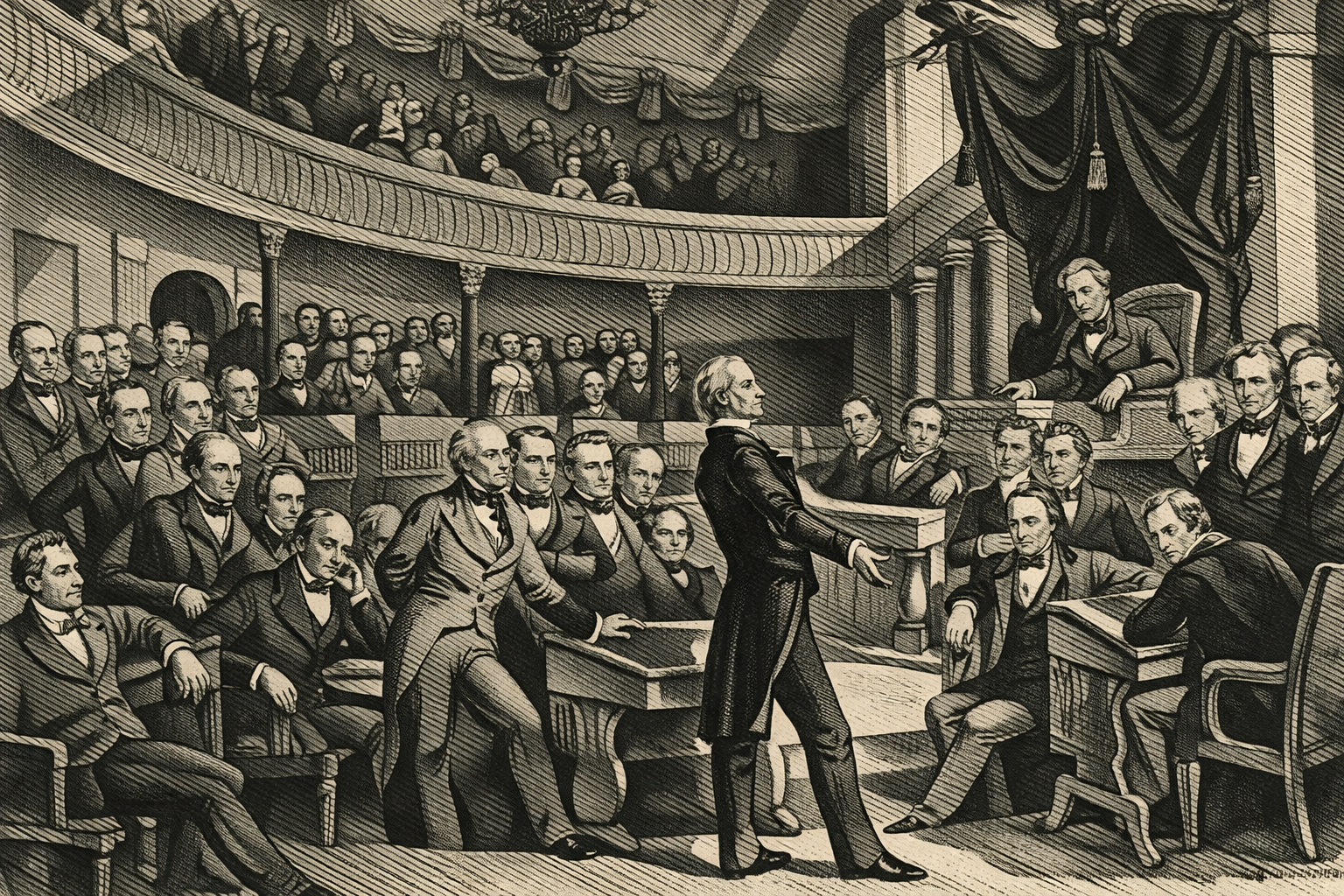
The United States Senate, A.D. 1850. Engraving after P.F. Rothermel.
Inside This Issue
Perspective and Fact
The line between perspective and fact is thinner than most assume. What one generation treats as settled science, the next may revise. What one culture considers a moral certainty, another views as an open question. Recognizing this is not relativism. It is intellectual honesty.
Facts establish what is. Perspectives determine what matters. A statistic about unemployment is a fact. Whether it represents a policy failure or an acceptable tradeoff is a perspective. Confusing the two is the root of most unproductive arguments.
Why It Matters
Political polarization has reached levels not seen in decades. Research consistently shows that people now view the opposing party not just as wrong, but as a threat. This shift did not happen because people stopped caring. It happened because they stopped listening.
Understanding an opposing view does not require adopting it. But it does require engaging with its strongest form, not the version that is easiest to dismiss. That is what separates genuine critical thinking from performance.
The Cost of Certainty
History is littered with confident majorities who turned out to be wrong. Certainty feels productive but it closes doors. The willingness to say "I might be mistaken" is not weakness. It is the prerequisite for learning anything new.
Societies that reward intellectual humility tend to innovate faster, resolve conflicts more peacefully, and adapt more effectively to change. Societies that punish doubt tend to stagnate, because no one is willing to voice the observation that the current path is not working.